


Content warning: This piece discusses child sex trafficking, sexual abuse, and exploitation of minors.
Les Wexner testified before the House Oversight Committee today about his decades-long relationship with Jeffrey Epstein. He delivered a three-page opening statement. It was carefully constructed—a document designed to sound reflective while sidestepping the hardest questions.
So let’s walk through it.
Because the record matters.
Before we get into this, a quick note.
This kind of reporting takes hours of reading FBI documents, depositions, property records, and cross-checking claims. I don’t put this work behind a paywall as many outlets do. It’s available to everyone.
If you value having access to document-based analysis like this, please consider subscribing. And if you’re able to become a paid subscriber or buy me a coffee, that support makes this work possible. It truly keeps me going.
Now let’s get into it.
Who is Les Wexner?
Leslie Wexner is an 88-year-old billionaire from Ohio. He founded The Limited and built a retail empire that included Victoria’s Secret, Bath & Body Works, Abercrombie & Fitch, Express, Lane Bryant, and Henri Bendel. He’s worth roughly nine billion dollars and has long been the richest person in Ohio.
He is also central to understanding how Jeffrey Epstein became wealthy, powerful, and socially insulated.
Wexner met Epstein in the mid-1980s. By 1991, he had granted Epstein unlimited power of attorney over his fortune — the authority to sign checks, borrow money, buy and sell real estate, hire employees, and sign tax returns without Wexner’s approval. Epstein effectively controlled the financial infrastructure of a billionaire for more than fifteen years.
Today, Wexner’s testimony framed him as a naive businessman who was conned.
Let’s examine that.
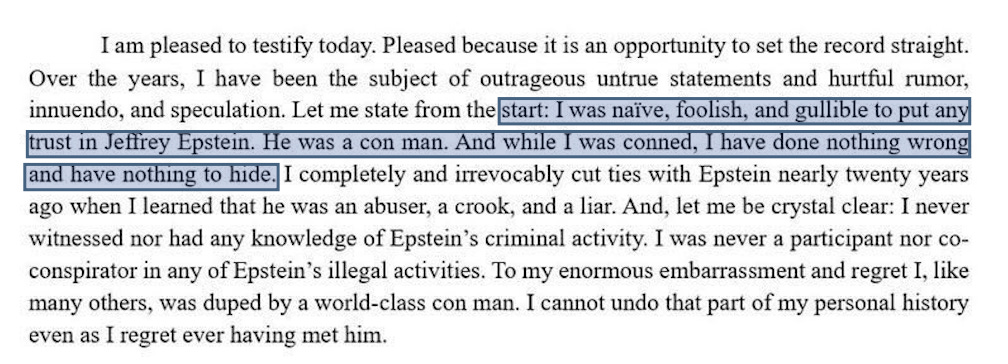
“I was naive, foolish, and gullible”
Wexner opens by describing himself as naive, foolish, and gullible.
But his own financial advisor, Harold Levin—the man who introduced him to Epstein—warned him early on. Levin reportedly told Wexner, “I smell a rat,” and said he did not trust Epstein. Instead of distancing himself, Wexner elevated Epstein’s authority and ultimately placed him in control of Levin.
That was not an absence of information. It was a decision made despite a warning from a trusted advisor.
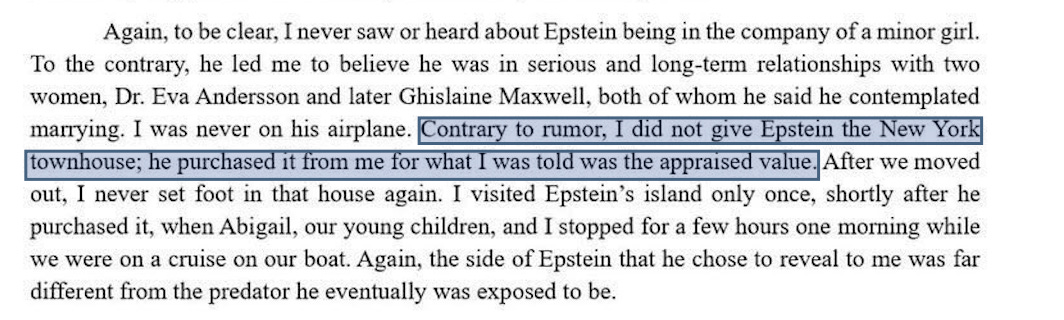
“I did not give Epstein the New York townhouse”
Wexner says Epstein “purchased it from me for what I was told was the appraised value.”
The townhouse in question is the largest private residence in Manhattan. Wexner purchased it in the 1980s for roughly $13 million.
The transfer history has raised longstanding questions. A 1998 property document reflected a $20 million price, though half of that amount was structured as a promissory note. Later reporting showed that ownership eventually transferred to an Epstein-controlled trust for little to no consideration. In 2019, a witness who identified himself as a former bodyguard told the FBI he believed the property had effectively been transferred for a nominal amount. That account has not been independently confirmed.
What is undisputed is this: the townhouse became one of the primary locations where Epstein abused victims.
Wexner’s phrasing focuses on technicalities. The broader reality remains.
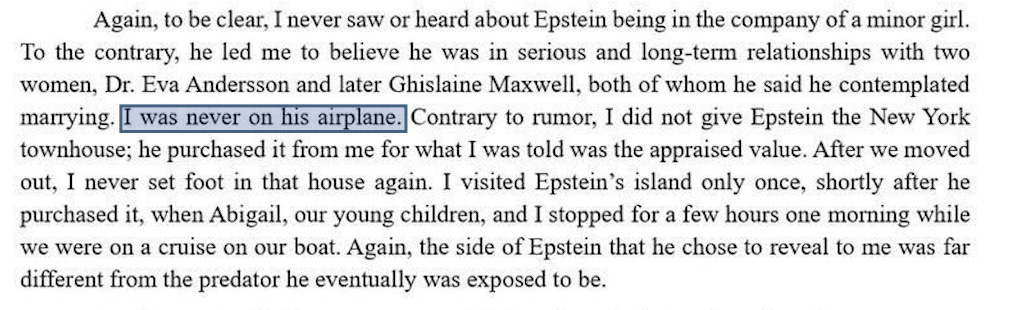
“I was never on his airplane”
Publicly released flight logs do not appear to show Wexner flying on Epstein’s Boeing 727.
But Epstein’s aircraft was originally owned by a Wexner-controlled company and reportedly maintained using Wexner-related funds before being transferred.
Physical presence is only one form of involvement. Asset control is another.
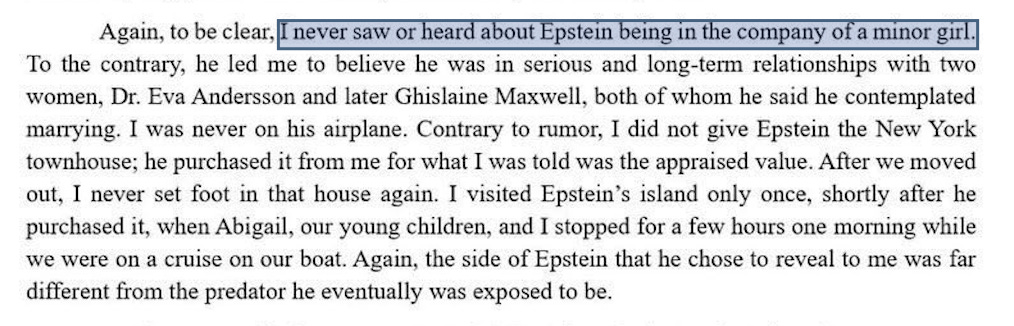
“I never saw or heard about Epstein being in the company of a minor girl”
This is the most legally precise sentence in Wexner’s statement.
Multiple survivors have alleged, under oath, that Wexner was aware of or present in circumstances involving exploitation. Virginia Giuffre has stated in deposition testimony that she was trafficked to powerful individuals connected to Epstein’s circle, including Wexner. Maria Farmer has alleged that Epstein assaulted her at Wexner’s Ohio property in 1996 during an artist residency that Epstein arranged.
Wexner has denied wrongdoing.
There is also an FBI intake report dated July 18, 2020, generated during the federal investigation into Epstein’s trafficking network. In that report, a witness described observing Epstein frequently in Wexner’s presence and described “private viewings” involving very young-looking models at Wexner’s compound. According to the witness, the compound operated with extensive security measures, including restricted floors and controlled access areas.
The witness further described an incident in which she and another stylist were dressing mannequins when Epstein and Wexner entered and watched them from behind while they were bent over. The witness characterized the environment as uncomfortable and surveilled.
An intake report reflects what a witness reported to investigators. It is not a judicial finding. But it is part of the investigative record.
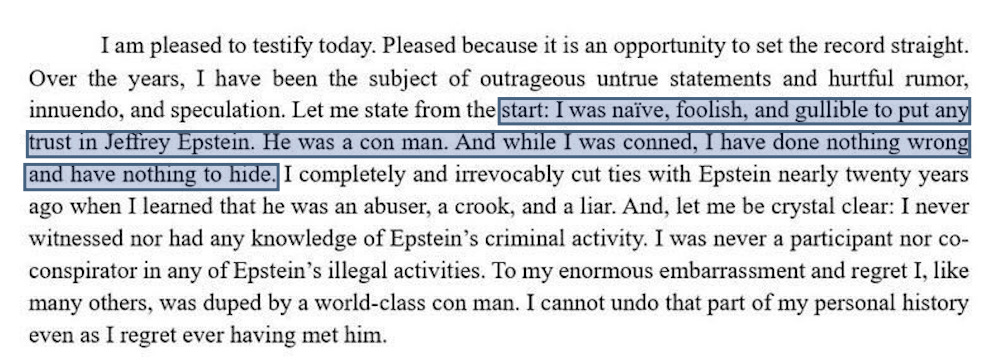
“I never witnessed, condoned, or enabled his crimes”
Wexner’s statement does not address the long-reported issue of Epstein presenting himself as connected to Victoria’s Secret in order to recruit young women.
Former executives and models have said that in the 1990s Epstein posed as a Victoria’s Secret talent scout to arrange meetings with young women. Reporting indicates that concerns about this behavior reached company leadership in the mid-1990s. At least one woman filed a police report in 1997 alleging sexual battery after a meeting she believed was related to modeling opportunities.
If those concerns were raised internally, the question becomes what actions were taken in response.
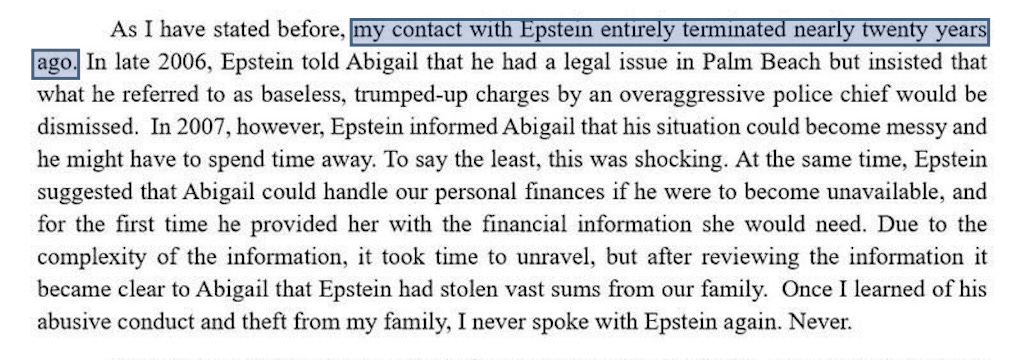
“My contact with Epstein entirely terminated nearly twenty years ago”
Wexner says he cut ties in 2007.
In 2003, however, he contributed to Epstein’s leather-bound 50th birthday album compiled by Ghislaine Maxwell, signing a note that included a crude drawing and referring to Epstein as “your friend.” A photograph of the two men appeared in the album.
By that point, Epstein’s pattern of predatory behavior had already been documented in complaints and civil filings.
The tone of that contribution reflected personal familiarity, not distant professional detachment.
What Wexner’s statement does not address
Wexner did not address reporting that his name appears extensively throughout investigative materials related to Epstein.
He did not address Maxwell’s description of him in correspondence as Epstein’s “closest friend.”
He did not address why the House Oversight Committee conducted the deposition at his New Albany compound rather than in Washington.
And he did not directly engage with the broader structural question: how Epstein was able to operate for decades inside elite financial and social circles.
The bottom line
Les Wexner built a multibillion-dollar retail empire. He did not achieve that by being incapable of assessing risk.
His testimony asks the public to believe that he granted extraordinary authority to a man despite warnings, failed to detect years of misconduct in proximity to his own assets and properties, and remained unaware of patterns that were visible to employees, survivors, and eventually law enforcement.
Ignorance can be an explanation. Over time, it also becomes a measure of what someone chose not to examine.
I’ll continue reviewing the deposition transcript as it becomes available.
If you want document-based breakdowns like this, make sure you’re subscribed. I keep this work outside a paywall so it’s accessible to everyone. If you find value in it and are able to support as a paid subscriber or buy me a coffee, that directly funds this reporting and allows me to keep doing it at the level it deserves.


