


The Department of Justice is preparing to propose a rule that would eliminate federal prosecutors’ ability to recuse themselves from cases due to conflicts of interest.
Instead, all conflict-of-interest decisions would be centralized in the hands of the Attorney General.
This proposal was first reported by Aaron Parnas. It has received surprisingly little attention. That is a mistake.
This may be the most quietly dangerous DOJ proposal of the year.
What the rule would do
Under existing DOJ ethics rules, prosecutors are required to step aside from cases when they have personal, financial, or political conflicts of interest, or even when there is an appearance of such a conflict.
The proposed rule would reverse that structure. Prosecutors would be required to remain on cases unless the Attorney General personally approves their recusal.
That is a fundamental shift in how federal prosecutions work. It eliminates not only mandatory recusal for actual conflicts, but also the more protective standard that has long required prosecutors to step aside when their participation would create even the appearance of impropriety.
Why federal law already forbids this
Congress has already spoken on this issue.
28 U.S.C. § 528 requires the Attorney General to promulgate rules that disqualify DOJ employees from cases in which they have conflicts of interest. The statute uses mandatory language. Disqualification is required when conflicts exist.
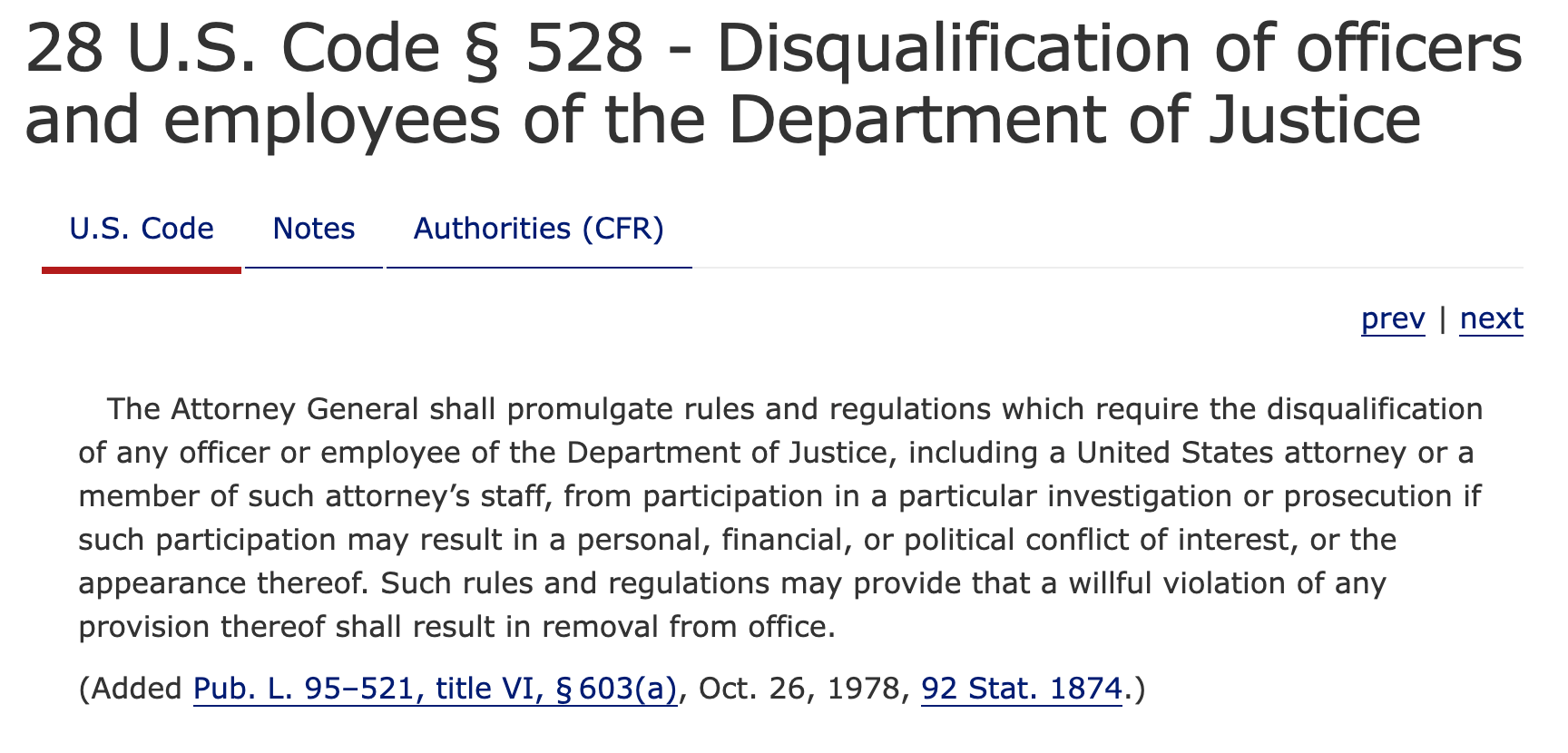
A regulation that forces conflicted prosecutors to remain on cases unless the Attorney General intervenes directly contradicts that statutory mandate.
Regulations cannot override statutes. Courts do not defer to agencies when Congress has spoken clearly. This one has.
The Administrative Procedure Act problem
Even if the statute were silent—which it is not—the proposal would still face serious problems under the Administrative Procedure Act.
Agencies cannot reverse decades of settled policy without a reasoned, evidence-based explanation. The Supreme Court reaffirmed this principle in Department of Homeland Security v. Regents of the University of California, holding that abrupt policy reversals require more than political justification.
Claims about “deep state resistance” or internal obstruction are political narratives, not legal justifications.
Courts regularly strike down rules that fail to grapple with reliance interests, ignore foreseeable consequences, or substitute ideology for analysis. This proposal does all three.
Due process consequences for defendants
This rule would immediately destabilize criminal prosecutions.
Defendants prosecuted by attorneys with identifiable conflicts of interest—particularly when those attorneys were ordered to remain on the case by a political appointee—would have strong due process arguments under the Fifth and Sixth Amendments.
Defense attorneys would move to dismiss cases, disqualify prosecution teams, and challenge convictions on appeal. Some of those motions would succeed.
This proposal does not strengthen prosecutions. It puts them at risk.
State bar rules still apply
Every DOJ attorney is licensed by a state bar. Those bars enforce their own conflict-of-interest rules.
The Attorney General cannot override the New York Bar. She cannot override the California Bar. She cannot override any state disciplinary authority.
DOJ attorneys would be forced to choose between complying with DOJ policy and protecting their law licenses. That alone makes the rule unworkable.
Why this is happening now
This proposal does not exist in a vacuum.
It follows repeated instances in which federal judges questioned or invalidated the appointments of conflicted, Trump-aligned prosecutors, including Alina Habba and Lindsey Halligan.
Courts enforced ethical limits. The response now appears to be an effort to eliminate the mechanism judges rely on to do so.
This centralizes prosecutorial power around political loyalty.
What happens next
Once this rule is published in the Federal Register, it will trigger a mandatory public comment period.
Those comments matter. Courts reviewing agency action look closely at the administrative record. Substantive objections make it harder for DOJ to defend an unlawful rule in litigation.
I will share the public comment link as soon as it goes live and explain how to submit comments that actually matter.
Because this proposal will be challenged. And it will lose.
Federal law says what it says. The Constitution says what it says. No amount of regulatory maneuvering changes that.
—
If you want continued reporting and analysis like this, please consider subscribing to Objection: Everything. Reader support is what makes this work possible.


