


Another day, another absolutely unhinged statement from the President.
This time, it was a threat to invoke the Insurrection Act in response to protests in Minnesota.
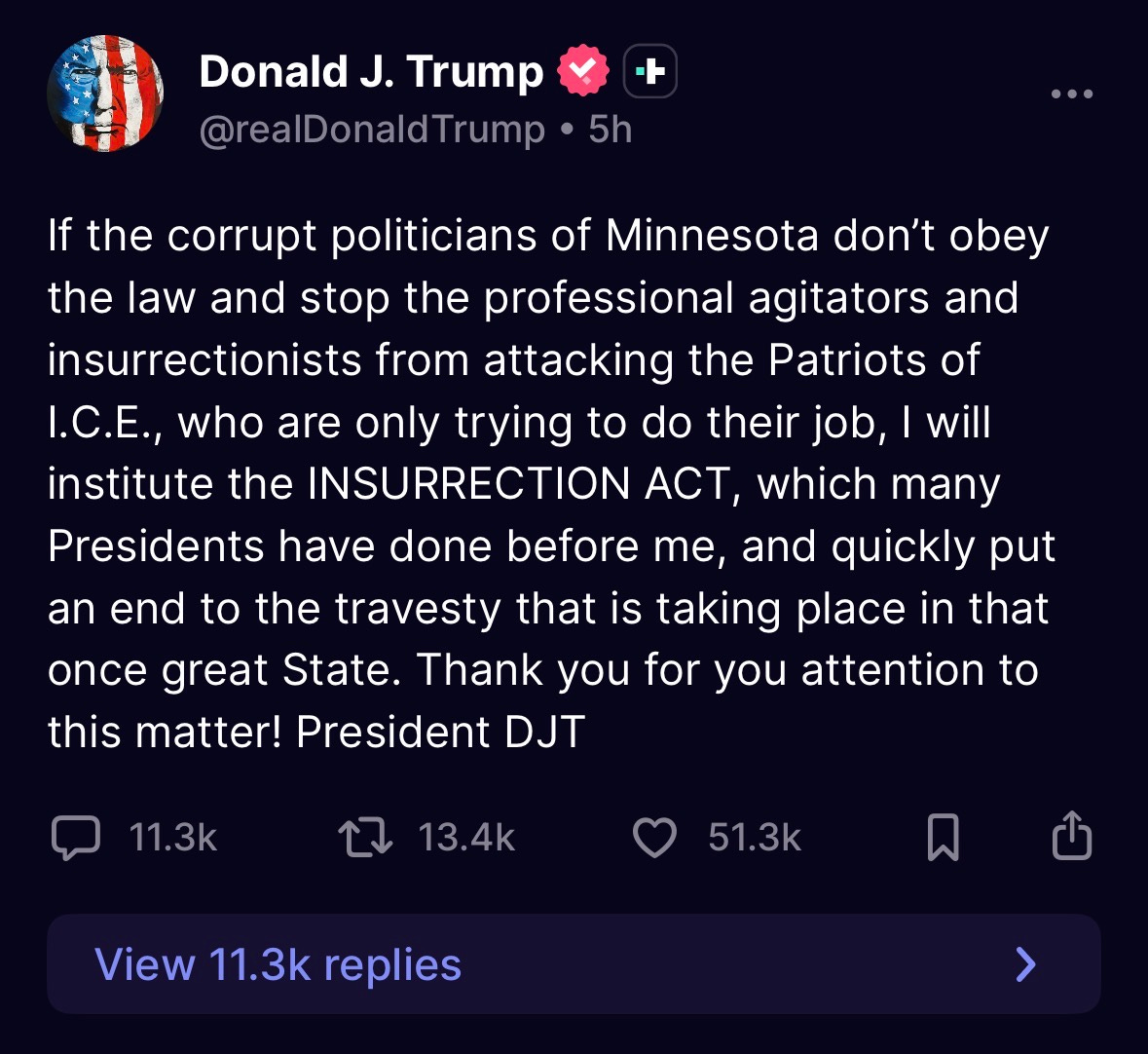
That should stop you cold.
The Insurrection Act is one of the most extreme domestic powers available to a president. It authorizes the use of the U.S. military inside the United States and operates largely outside the guardrails people assume will constrain executive action.
Let me explain.
What the Insurrection Act actually does
The Insurrection Act is a collection of federal statutes, originally enacted in 1807, that authorizes a president to deploy the U.S. military inside the United States, including federal troops and active-duty service members rather than the National Guard operating under a governor’s control.
That authority can be invoked when a president claims that state officials are unwilling or unable to protect constitutional rights, or when the president determines that an “insurrection” is obstructing the execution of federal law. Crucially, that determination is made by the president alone.
The statute contains no requirement for prior judicial approval and no automatic congressional check. Courts have historically treated invocation of the Insurrection Act as a political question, which has made them deeply reluctant to intervene or second-guess a president’s judgment in real time.
As written, the law depends on restraint and good faith rather than enforcement. It assumes that the extraordinary nature of the power itself will deter abuse.
That assumption is doing a lot of work right now.
How the Act has been used in the past
Historically, the Insurrection Act has been invoked rarely, and usually in narrow circumstances.
Presidents relied on it during the Civil Rights era to enforce federal court orders when states refused to desegregate schools. It was used in situations involving actual armed resistance, or when state governments openly defied constitutional mandates.
The most recent large-scale invocation occurred in 1992, during the Los Angeles riots, and it was done at the request of California’s governor.
Those historical uses matter, because they are often cited to normalize modern threats. “Other presidents have done this before” is technically true and substantively misleading.
Past invocations were tied to enforcing constitutional rights or responding to breakdowns of public order that state governments could not manage. They were not framed as punishment for political dissent.
What is happening in Minnesota
In Minnesota, people are protesting ICE operations and demanding accountability after a federal agent shot and killed Renee Good ON VIDEO.
Those protests are not an insurrection. Civil disobedience is not armed rebellion. Protest against federal policy is not a breakdown of constitutional order.
When a president labels protesters “insurrectionists,” that language does not simply describe events. It reshapes them. It converts dissent into rebellion. It reframes accountability as obstruction. It lays the groundwork for military force.
That shift in language is the point.
The legal danger
The Insurrection Act has almost no built-in oversight. Legal challenges to its use are possible, but they happen after deployment, not before.
That matters.
To understand why, you have to understand the Posse Comitatus Act.
Enacted in 1878 in the aftermath of Reconstruction, Posse Comitatus generally prohibits the use of the U.S. military for domestic law enforcement. The principle behind it is straightforward: soldiers are trained for war, not policing. Military force against civilians—outside of an actual invasion or armed rebellion—is fundamentally incompatible with democratic governance.
The Insurrection Act is the primary exception to that rule.
When a president invokes the Insurrection Act, the prohibition imposed by Posse Comitatus lifts. Federal troops can be deployed domestically. The ordinary legal barriers that separate military force from civilian life disappear.
This is why the Insurrection Act is so dangerous. It is not constrained by Posse Comitatus. It overrides Posse Comitatus.
Courts can later determine that a particular use of the Act was unconstitutional. They can assess First Amendment violations. They can examine whether the circumstances actually justified suspending the long-standing prohibition on domestic military deployment.
But those determinations come later.
By the time the law catches up, troops are already deployed. People are already injured. Speech has already been suppressed. The chilling effect has already taken hold.
Emergency powers operate on that lag. That is why they are dangerous when they are normalized.
Why this moment is different
This moment is not defined by a single post or a single threat. It reflects a broader pattern in which political opposition is reframed as criminal rebellion, protest is treated as violence, and federal power is positioned as the solution to dissent rather than the object of accountability.
When a president publicly threatens to deploy the military against a state because its residents are protesting federal action, that is not governance. It is intimidation, and it signals a shift in how dissent is understood and addressed.
Whether or not the Insurrection Act is ultimately invoked matters less than the conditioning itself. Repetition lowers resistance. Normalization dulls alarm. Over time, language that once would have triggered outrage begins to feel procedural.
Authoritarian power rarely arrives all at once. It enters through words first, preparing the ground for actions that would once have been unthinkable.
Why paying attention matters
The Insurrection Act sits at the intersection of military power, executive discretion, and domestic dissent. It depends almost entirely on restraint rather than enforcement.
When restraint erodes, the statute becomes something else entirely.
Understanding what this law actually does is not academic. It is a prerequisite to recognizing when lines are being crossed—and why those lines exist in the first place.
—
If you find this work useful, please consider subscribing to Objection: Everything. I keep this work free and accessible, and paid subscriptions are what allow me to keep publishing independently.


